🎉 14+ Years Anniversary Special! | 50% OFF on All Training Courses | Limited Time Only!
sivasoft@sivasoft.in An ISO 9001:2015 Certified Company
+91 99636 89248 Ameerpet, Hyderabad
Special Design Track

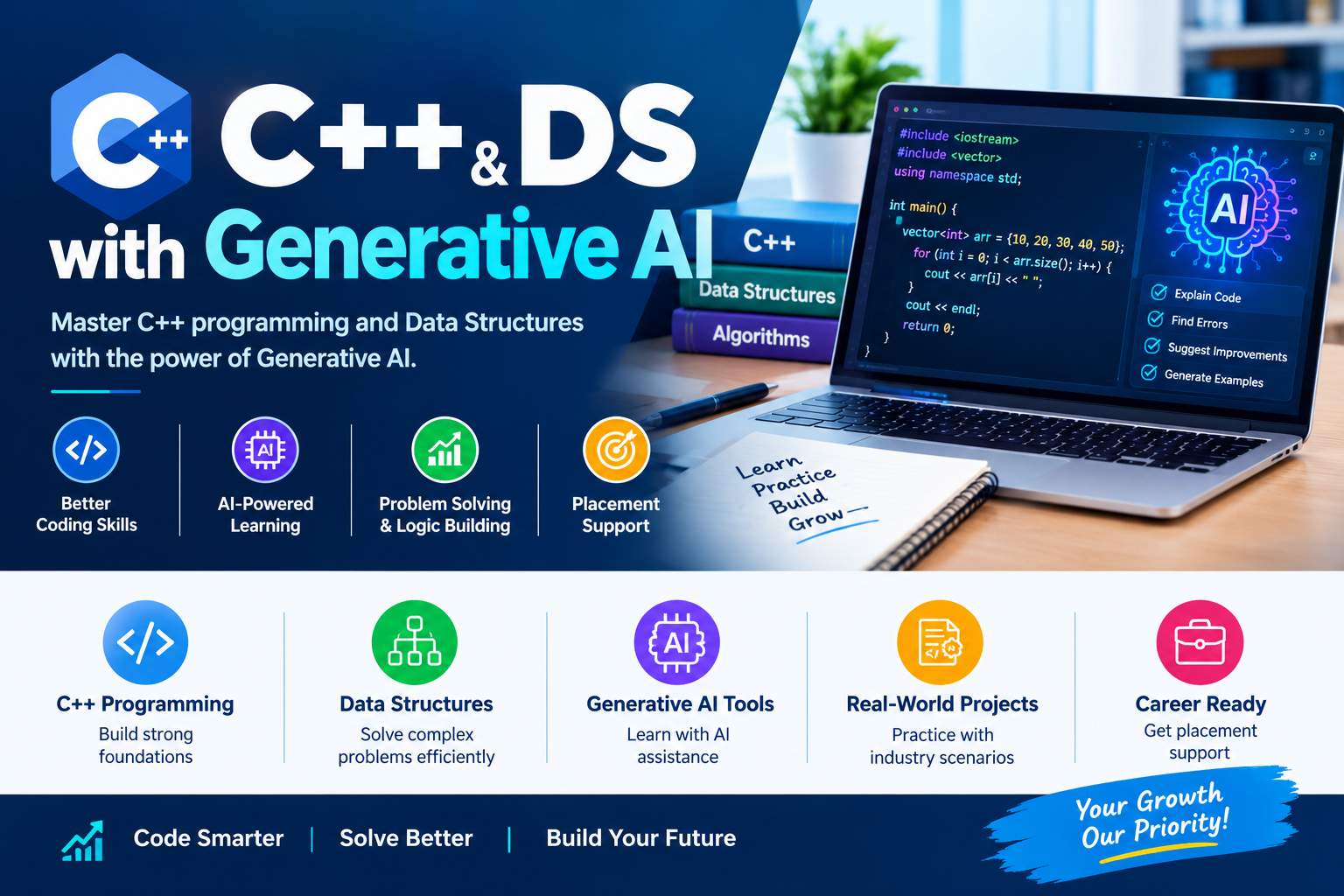
🎓 C++ & DSA with Generative AI Training Course

Master C++ Programming & DSA with programming logic, memory management, pointers, Data Structures & Algorithms, and AI-powered coding tools (ChatGPT, Gemini, and GitHub Copilot). Gain hands-on experience through practical projects and real-world problem-solving exercises.

Duration 1.5 Months
Training Mode Classroom & Live Online
Trainers Ms. Lakshmi • Mr. Mani • Mr. Manohar 12+ Yrs Industry Experts
Online C and DS Training Course
Fee Structure & Limited Offers: 6 Months
Note for Students: The Complete Course Syllabus & Certificate are identical across all options. Only the batch mode and pricing differ.
Group Online Fee You Save ₹6,000
₹6,000 ₹12,000
Classroom Fee You Save ₹12,000
₹12,000 ₹24,000
One-to-One Online You Save ₹12,000
₹12,000 ₹24,000
Share Course:

Program Key Benefits

Master Skills: Hands-on training from top corporate professionals.
One-on-One Demo: Get Personalized Training & Clarifications before getting started.
Expert Trainers: Led by Ms. Lakshmi(12+Yrs) Mr.Mani(12+Yrs) Mr.Manohar(10+Yrs), successfully completing 60+ batches.
Unlimited Practice: Dedicated Computer Lab Access.
Lifetime Access: Class Recorded Videos provided.
Eligibility: Open to 12th Pass Students, Graduates from Any Stream & Individuals with Career Gaps.
Certificates: Free Training Completion Certificate (Soft Copy) provided.
Doubt Clarification: Support via Live Classes, WhatsApp, and LMS.
Program Duration: Comprehensive 1.5 Months training schedule.

Tools & Technologies Covered

C++ Programming Fundamentals Introduction to C++ and OOP Concepts C++ Environment and Program Structure Variables, Data Types and Operators Control Statements and Loops Functions and Recursion Arrays, Pointers and References Strings and String Manipulation Classes and Objects Constructors and Destructors Operator Overloading Inheritance and Polymorphism Virtual Functions and Abstraction Templates and Generic Programming Exception Handling File Handling and Streams Dynamic Memory Management Standard Template Library (STL) Data Structures and Algorithms (DSA) Arrays, Linked Lists and Matrices Stacks and Queues Searching and Sorting Algorithms Trees, Binary Search Trees and Heaps Graphs and Graph Algorithms Hashing and Hash Tables Greedy Algorithms and Dynamic Programming Problem Solving and Competitive Programming Object-Oriented Design and Software Development Generative AI for C++ Programming ChatGPT, GitHub Copilot and Google Gemini AI-Assisted Coding and Debugging Real-Time Projects and Portfolio Development C++ DSA Interview Preparation

Complete Course Syllabus

Programming Fundamentals
  • Introduction to C++ and Its Features
  • Structure of a C++ Program
  • Compilation and Execution Process
  • Keywords, Identifiers and Variables
  • Data Types and Constants
  • Type Conversion and Type Casting
  • Operators and Expressions
  • Conditional Statements: if, if-else, switch
  • Loops: for, while, do-while
  • break, continue and return
  • Arrays and Multidimensional Arrays
  • Functions and Function Prototypes
  • Scope and Lifetime of Variables
Object-Oriented Programming
  • Limitations of Procedural Programming
  • Need for Object-Oriented Programming
  • Classes and Objects
  • Encapsulation and Abstraction
  • Inheritance and Polymorphism
  • Benefits of OOP: Reusability and Maintainability
  • Difference Between C and C++
  • How C++ Supports the OOP Paradigm
  • Real-World Applications of OOP

  • Scope Resolution Operator (::)
  • const and constexpr
  • Reference Variables and Aliases
  • Pointer vs Reference
  • Passing Parameters by Reference
  • Inline Functions
  • Function Overloading
  • Default Arguments in Functions
  • Variadic Functions and Parameter Packs
  • Function Pointers
  • Dynamic Memory Allocation: new and delete
  • Namespaces and Namespace Resolution
  • Type Aliases: typedef and using
  • auto, decltype and nullptr

  • Defining Classes and Creating Objects
  • Access Specifiers: public, private, protected
  • Data Members and Member Functions
  • Member Functions Inside and Outside Classes
  • Memory Allocation of Objects and Members
  • Static Data Members
  • Static Member Functions
  • Const Objects and Const Member Functions
  • Nested Classes
  • Anonymous Objects and Temporary Objects
  • Anonymous Classes and Unnamed Class Types
  • The this Pointer
  • Friend Functions and Friend Classes
  • Arrays of Objects
  • Object Pointers and Object References
  • Encapsulation with Real-World Examples

  • Purpose and Need for Constructors
  • Default Constructors
  • Parameterized Constructors
  • Copy Constructors
  • Move Constructors
  • Dynamic Constructors
  • Constructor Overloading
  • Constructors with Default Arguments
  • Explicit Constructors
  • Shallow Copy vs Deep Copy
  • Destructor Syntax and Usage
  • Constructor and Destructor Execution Order
  • Constructors and Destructors in Inheritance
  • Member Initialization Lists
  • Delegating Constructors
  • Copy and Move Assignment Operators
  • RAII and Resource Management

  • Introduction to Operator Overloading
  • Overloadable and Non-Overloadable Operators
  • Unary Operator Overloading
  • Binary Operator Overloading
  • Member Functions vs Friend Functions
  • Arithmetic Operators
  • Relational and Equality Operators
  • Assignment Operators
  • Subscript [] Operator
  • Function Call () Operator
  • Stream Insertion (<<) and Extraction (>>)
  • Type Conversion Operators
  • Increment and Decrement Operators
  • Operator Overloading Best Practices

  • Introduction to Inheritance and Its Benefits
  • Base and Derived Class Syntax
  • Single Inheritance
  • Multilevel Inheritance
  • Multiple Inheritance
  • Hierarchical Inheritance
  • Hybrid Inheritance
  • Public, Protected and Private Inheritance
  • Constructor and Destructor Calls in Inheritance
  • Function Overriding
  • Object Slicing
  • Protected Members
  • Virtual Base Classes
  • The Diamond Problem
  • Inheritance and Memory Layout
  • Composition vs Inheritance

  • Introduction to Polymorphism
  • Compile-Time Polymorphism
  • Function and Operator Overloading
  • Runtime Polymorphism
  • Virtual Functions
  • Base-Class Pointers and Derived-Class Objects
  • Virtual Tables (VTables) and VPTRs
  • Pure Virtual Functions
  • Abstract Classes and Interfaces
  • Rules and Limitations of Virtual Functions
  • Virtual Destructors
  • override and final Keywords
  • Function Overriding vs Function Hiding
  • Dynamic Binding and Late Binding

  • Introduction to Templates
  • Function Templates
  • Single and Multiple Template Parameters
  • Template Argument Deduction
  • Class Templates
  • Class Templates with Multiple Types
  • Non-Type Template Parameters
  • Full and Partial Template Specialization
  • Templates and Inheritance
  • Variadic Templates
  • Generic Programming Fundamentals
  • Introduction to STL
  • Reusable Template Components

  • Need for Exception Handling
  • Errors vs Exceptions
  • try-catch Blocks
  • Throwing Exceptions Using throw
  • Multiple catch Blocks
  • Catching All Exceptions
  • Throwing Objects and Standard Exceptions
  • Nested try-catch Blocks
  • Rethrowing Exceptions
  • Custom Exception Classes
  • Stack Unwinding
  • Exception Safety and Resource Management
  • Error Handling Best Practices

  • Introduction to Input/Output Streams
  • Standard Streams: cin, cout, cerr and clog
  • Formatted and Unformatted Input/Output
  • Output Formatting with Manipulators
  • Precision and Number Formatting
  • Using getline(), get() and put()
  • Stream State Flags
  • Input Validation and Error Handling
  • String Streams: stringstream, istringstream and ostringstream

  • C-Style Character Arrays
  • Null-Terminated Strings
  • Introduction to std::string
  • String Length and Capacity
  • Character Access and Substrings
  • length(), size(), substr() and find()
  • insert(), erase(), replace() and append()
  • String Concatenation and Comparison
  • String Traversal and Iteration
  • stoi(), stod() and to_string()
  • String Streams for Parsing
  • wstring and wchar_t
  • Unicode and Character Encoding Fundamentals
  • String-Based Problem-Solving Exercises

  • Introduction to File Handling
  • ifstream, ofstream and fstream
  • Opening and Reading Text Files
  • Writing and Appending Files
  • File Opening Modes
  • Binary File Operations
  • seekg(), seekp(), tellg() and tellp()
  • Detecting File Errors and Stream States
  • Reading and Writing Structured Records
  • Serialization Fundamentals
  • File-Based Data Storage
  • Practical File Handling Exercises

  • Modern C++ Standards: C++11, C++14, C++17 and C++20
  • Stack Memory vs Heap Memory
  • Pointers and Pointer Arithmetic
  • Null, Dangling and Wild Pointers
  • Dynamic Memory Allocation
  • Memory Leaks and Prevention
  • Smart Pointers: unique_ptr, shared_ptr and weak_ptr
  • Move Semantics
  • Lvalues and Rvalues
  • Lambda Expressions
  • Range-Based for Loops
  • Iterators and const Correctness
  • auto, decltype and constexpr
  • RAII and Resource Management
  • Introduction to Multithreading and Concurrency

STL Containers
  • Introduction to STL Components
  • Containers, Iterators and Algorithms
  • Sequence Containers: array, vector, deque and list
  • Container Adapters: stack, queue and priority_queue
  • Associative Containers: set, multiset, map and multimap
  • Unordered Containers: unordered_set and unordered_map
STL Algorithms
  • Iterator Types and Operations
  • sort(), find(), count() and reverse()
  • Searching and Comparison Algorithms
  • Lambda Functions with STL
  • Custom Comparators
  • Pairs and Tuples
  • Choosing the Right Container
  • STL-Based Coding Exercises

A. DSA Fundamentals
  • Introduction to Data Structures and Algorithms
  • Linear and Non-Linear Data Structures
  • Abstract Data Types (ADTs)
  • Algorithm Design and Problem-Solving Strategies
  • Time and Space Complexity
  • Big O, Big Omega and Big Theta Notations
  • Best, Average and Worst-Case Analysis
  • Recursion and Iteration
B. Arrays and Matrices
  • Traversal, Insertion and Deletion
  • One-Dimensional and Multidimensional Arrays
  • Matrix Operations
  • Prefix Sums
  • Sliding Window Technique
  • Two-Pointer Technique
  • Duplicates and Missing Elements
  • Maximum Subarray Sum
C. Searching Algorithms
  • Linear Search
  • Binary Search
  • Binary Search on Sorted Data
  • First and Last Occurrence
  • Lower Bound and Upper Bound
  • Search in Rotated Sorted Arrays
  • Search-Based Problem Solving
D. Sorting Algorithms
  • Bubble Sort
  • Selection Sort
  • Insertion Sort
  • Merge Sort
  • Quick Sort
  • Heap Sort
  • Counting Sort Fundamentals
  • Stable vs Unstable Sorting
  • In-Place vs Out-of-Place Sorting
  • STL sort() and Custom Comparators
E. Linked Lists
  • Introduction to Linked Lists
  • Singly Linked Lists
  • Doubly Linked Lists
  • Circular Linked Lists
  • Node Creation and Memory Allocation
  • Insertion, Deletion and Searching
  • Reversing a Linked List
  • Detecting Cycles
  • Finding the Middle Node
  • Merging Sorted Linked Lists
F. Stacks and Queues
  • Stack and LIFO Principle
  • Stack Using Arrays and Linked Lists
  • Push, Pop and Peek Operations
  • Queue and FIFO Principle
  • Simple and Circular Queues
  • Deque and Priority Queue
  • Balanced Parentheses
  • Infix, Prefix and Postfix Expressions
  • Next Greater Element
  • Queue-Based Scheduling
G. Hashing
  • Hash Functions and Hash Tables
  • Collision Handling
  • Chaining and Open Addressing
  • Hash Maps and Hash Sets
  • Frequency Counting
  • Duplicate Detection
  • Two-Sum Problems
  • unordered_map and unordered_set
H. Trees and Binary Search Trees
  • Tree Terminology and Properties
  • Binary Trees and Their Representation
  • Preorder, Inorder and Postorder Traversal
  • Level-Order Traversal
  • Binary Search Trees (BST)
  • Insertion, Searching and Deletion in BST
  • Tree Height and Depth
  • Balanced Trees Overview
  • Min Heap and Max Heap
  • Priority Queue Applications
I. Graphs
  • Vertices and Edges
  • Directed and Undirected Graphs
  • Weighted and Unweighted Graphs
  • Adjacency Matrix and Adjacency List
  • Breadth-First Search (BFS)
  • Depth-First Search (DFS)
  • Cycle Detection and Connected Components
  • Dijkstra's Algorithm
  • Prim's and Kruskal's Algorithms
  • Topological Sorting
  • Real-World Graph Applications
J. Recursion and Backtracking
  • Base Cases and Recursive Cases
  • Call Stack and Recursive Execution
  • Factorial and Fibonacci
  • Recursive Array and String Problems
  • Subsets and Subsequences
  • Permutations and Combinations
  • Maze and Path-Finding Problems
  • N-Queens Problem
  • Sudoku Solver Fundamentals
K. Greedy Algorithms and Dynamic Programming
  • Greedy Algorithm Fundamentals
  • Activity Selection
  • Interval Scheduling
  • Coin Change Fundamentals
  • Memoization and Tabulation
  • Fibonacci Using Dynamic Programming
  • Climbing Stairs
  • 0/1 Knapsack
  • Longest Common Subsequence
  • Longest Increasing Subsequence
  • Minimum-Cost Path Problems
  • Greedy vs Dynamic Programming
L. Advanced Problem-Solving
  • Bit Manipulation
  • Sliding Window Technique
  • Two-Pointer Technique
  • Prefix and Suffix Techniques
  • Monotonic Stack Fundamentals
  • Union-Find / Disjoint Set Union
  • Trie Data Structure
  • Interval-Based Problems
  • Competitive Programming Fundamentals
  • Coding Interview Problem Patterns
  • DSA Practice Using C++

  • Procedural vs Object-Oriented Development
  • Object-Oriented Analysis and Design
  • Requirements Gathering and Use Cases
  • UML Notations and Diagrams
  • Class Diagrams
  • Object Diagrams
  • Sequence Diagrams
  • Use Case Diagrams
  • SOLID Design Principles
  • DRY and YAGNI Principles
  • Composition and Dependency Management
  • Factory Design Pattern
  • Singleton Design Pattern
  • Strategy Design Pattern
  • Code Organization and Reusability
  • Software Testing and Debugging
  • Git Version Control Fundamentals

A. Generative AI Fundamentals
  • Introduction to Generative AI
  • Large Language Models (LLMs)
  • Applications of AI in Software Development
  • Benefits and Limitations of AI-Assisted Programming
  • Responsible AI Usage and Code Verification
B. ChatGPT for C++ Development
  • Introduction to ChatGPT
  • Generating C++ Programs
  • Understanding C++ Syntax and OOP
  • Generating Functions, Classes and Templates
  • Debugging Compilation Errors
  • Understanding Pointers and Memory Management
  • Generating DSA Solutions Step by Step
  • Comparing Algorithm Approaches
  • Time and Space Complexity Analysis
  • Generating Unit Tests and Edge Cases
  • Code Refactoring and Optimization
  • Writing Effective Programming Prompts
C. Google Gemini for C++
  • Introduction to Google Gemini
  • Generating C++ Code and Explanations
  • Understanding Complex Programs
  • Debugging and Troubleshooting
  • Exploring Alternative DSA Solutions
  • Generating Coding Challenges
  • Reviewing and Improving Existing Code
D. GitHub Copilot
  • Introduction to GitHub Copilot
  • Setting Up Copilot in a Supported IDE
  • AI-Powered Code Completion
  • Generating Functions and Classes
  • Writing Comments and Documentation
  • Creating Unit Tests
  • Refactoring and Improving Code
  • AI-Assisted Debugging
  • Using Copilot for DSA Practice
  • Reviewing Code Correctness and Security
E. AI-Assisted Problem Solving
  • Breaking Requirements into Tasks
  • Writing Algorithms and Pseudocode
  • Generating C++ Implementations
  • Testing Sample Inputs and Edge Cases
  • Comparing Brute-Force and Optimized Solutions
  • Validating Complexity Analysis
  • Identifying Memory and Performance Issues
  • Verifying AI-Generated Code

Hands-On Project Development

Apply C++ programming, OOP, file handling, STL, DSA and AI-assisted coding techniques to practical projects.

Technical Interview Preparation
  • C++ Fundamentals Interview Questions
  • OOP Concepts and Real-World Examples
  • Constructors and Destructors
  • Pointers, References and Smart Pointers
  • Inheritance and Polymorphism
  • STL and Modern C++ Questions
  • DSA Interview Questions
  • Time and Space Complexity Analysis
Career Readiness
  • Coding Challenges and Mock Interviews
  • Debugging and Code-Review Exercises
  • AI-Assisted Interview Practice
  • Resume Preparation
  • Project Portfolio Preparation
  • Technical Interview Practice
  • Problem-Solving Sessions