🎉 14+ Years Anniversary Special! | 50% OFF on All Training Courses | Limited Time Only!
sivasoft@sivasoft.in An ISO 9001:2015 Certified Company
+91 99636 89248 Ameerpet, Hyderabad
Special Career Track

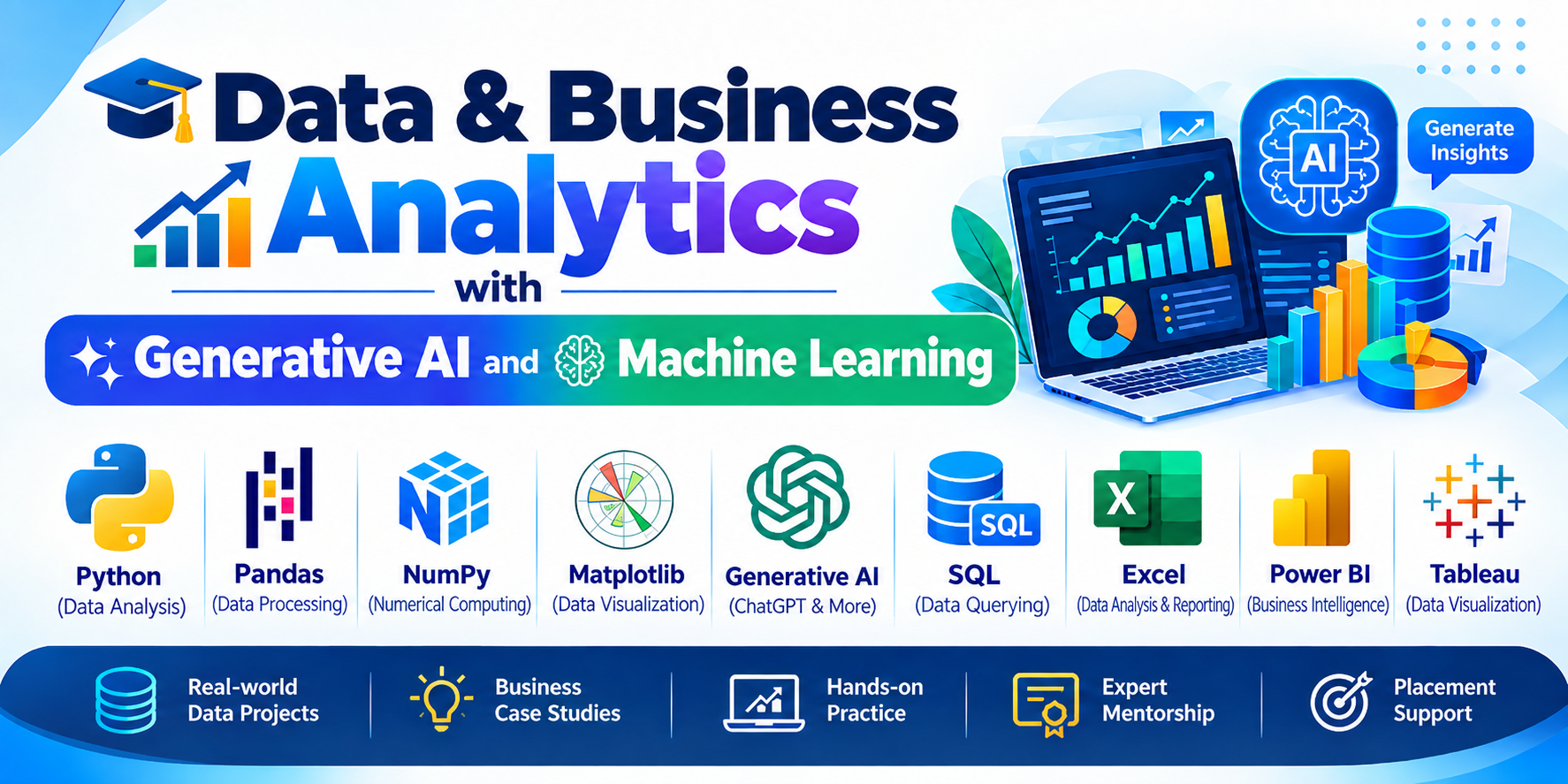
🎓 Data & Business Analytics with Generative AI, Machine Learning, Python, SQL, Power BI, Tableau & Microsoft Azure Training Course with Internship – 100% Job Placement-Oriented Training Course

Master Data Analytics, Business Intelligence, Machine Learning, and Generative AI through industry-oriented training and hands-on real-time projects. Learn to analyze data, build interactive dashboards, automate business processes, generate AI-powered insights, and make data-driven business decisions using industry-relevant tools and technologies.

Duration 6 Months
Training Mode Classroom & Live Online
Trainer Mr. Siva • Mr. Mani • Mr. Sharif — 15+ Yrs Experience
Online Angular & Generative AI Training Course
50% Anniversary Discount ₹30,000

₹15,000

/ Complete Program

Accredited & Recognized Excellence

MCA Government of India Logo
ISO 9001:2015 Certification Logo
MCA Government of India Logo
ISO 9001:2015 Certification Logo

Program Key Benefits

Master Skills: Industry-relevant skills with hands-on training from top corporate professionals.
Eligibility: Open to Any Graduates and individuals with Career Gaps.
Expert Trainers: Led by Mr. Siva • Mr. Mani • Mr. Sharif (15+ Yrs experience), successfully completing 80+ batches.
Program Duration: Comprehensive 6 Months training schedule.
Lifetime Live Classes & Video Access: Lifetime access to live classes and recorded videos for learning, revision, and practice.
Doubt Clarification: Support via Live Classes, WhatsApp, and LMS.
Assessments: Regular Interview Questions and Code Assessments included.
Career Support: Resume Preparation, LinkedIn Profile Creation, and Portfolio Website Development.
Certificates: Free Training Completion Certificate (Soft Copy) provided.
Industry Terms & Tips: Coverage of Agile, Scrum, Monitoring, and corporate career success strategies.
One-on-One Demo: Get Personalized Training & Clarifications before getting started.

Tools & Technologies Covered

Core & Advanced Python NumPy, Pandas & Matplotlib Business Statistics Machine Learning SQL (SQL Server, Oracle, MySQL, PostgreSQL) NoSQL (MongoDB, DynamoDB) Microsoft Excel (Basic & Advanced) Microsoft Power BI Tableau Microsoft Cloud: Azure Microsoft Power Automate Business Process Analysis Financial, Marketing & Sales Analytics Customer & Supply Chain Analytics Predictive Analytics Agile, Jira & Confluence Generative AI Tools (CoPilot, ChatGPT, Gemini) 10 Practical Projects

Complete Course Syllabus

  • Introduction to Programming and Python
  • History, Features, Advantages, and Applications of Python
  • Python vs. Other Programming Languages
  • Installing Python and Setting Up the Environment
  • Python Interpreter and Execution Process
  • Python Interactive Mode and Script Mode
  • IDEs: IDLE, VS Code, and PyCharm
  • Writing and Executing the First Python Program

  • Variables, Keywords, and Identifiers
  • Naming Conventions and Comments
  • Literals and Types of Literals
  • Numeric, String, Boolean, and None Literals
  • Collection Literals: List, Tuple, Set, and Dictionary
  • Python Built-in Data Types
  • Type Checking Using type() and Object Identity Using id()
  • Type Conversion and Type Casting
  • Built-in Conversion Functions: int(), float(), str(), bool()
  • Collection Conversions: list(), tuple(), set(), and dict()
  • User Input Using input()
  • Output Using print() and Parameters sep and end
  • String Formatting: f-strings, format(), and % Formatting
  • Multiple Assignment and Variable Unpacking
  • Comments, Indentation, and Basic Python Syntax

  • Arithmetic Operators
  • Comparison and Logical Operators
  • Assignment and Compound Assignment Operators
  • Bitwise Operators
  • Membership Operators: in and not in
  • Identity Operators: is and is not
  • Difference Between == and is
  • Operator Precedence and Associativity
  • Practical Programs Using Python Operators

  • Introduction to Decision-Making
  • if Statement
  • if-else Statement
  • if-elif-else Statement
  • Nested if Statements
  • Conditional Expressions (Ternary Operator)
  • match-case Statement (Python 3.10+)
  • Truth Values and Conditions
  • Real-Time Decision-Making Programs

  • Introduction to Iteration and Loops
  • while Loop and for Loop
  • range() Function and Its Variations
  • Nested Loops
  • break, continue, and pass Statements
  • else with for and while Loops
  • Loop Control and Infinite Loops
  • Pattern Programming
  • Number and Sequence-Based Programs
  • Real-Time Loop Examples

  • String Creation and String Literals
  • Indexing, Negative Indexing, and Slicing
  • String Immutability and String Operators
  • String Concatenation and Repetition
  • String Searching Methods: find(), rfind(), index(), rindex()
  • Case Conversion Methods: upper(), lower(), title(), capitalize(), swapcase()
  • String Validation Methods: isalpha(), isdigit(), isalnum(), isspace(), islower(), isupper()
  • String Cleaning Methods: strip(), lstrip(), rstrip()
  • String Replacement and Translation Methods
  • String Splitting and Joining: split(), rsplit(), splitlines(), join()
  • String Partitioning: partition() and rpartition()
  • String Prefix and Suffix Checking: startswith() and endswith()
  • String Formatting: format(), format_map(), and f-strings
  • String Alignment: center(), ljust(), and rjust()
  • Raw Strings and Escape Sequences
  • String Validation, Manipulation, and Processing Programs

  • Introduction to Python Collections
  • Lists: Creation, Indexing, Slicing, and Methods
  • List Operations: append(), extend(), insert(), remove(), pop(), clear()
  • List Searching and Sorting: index(), count(), sort(), reverse()
  • List Copying and Nested Lists
  • List Comprehensions and Conditional Comprehensions
  • Tuples: Creation, Indexing, Slicing, Packing, and Unpacking
  • Tuple Methods: count() and index()
  • Sets: Creation, Uniqueness, and Set Operations
  • Set Methods and Mathematical Set Operations
  • Frozensets: Concepts and Operations
  • Dictionaries: Keys, Values, Items, and Methods
  • Dictionary Methods: get(), update(), pop(), setdefault(), and items()
  • Dictionary Iteration and Dictionary Comprehensions
  • Nested Collections and Collection Unpacking
  • Mutable vs. Immutable Objects
  • Collection Conversion and Common Collection Operations

  • Introduction to Functions and Modular Programming
  • Defining and Calling Functions Using def
  • Parameters, Arguments, and Function Calls
  • Positional, Keyword, and Default Arguments
  • Variable-Length Arguments: *args and **kwargs
  • Return Statements and Returning Multiple Values
  • Local and Global Variables
  • Variable Scope and the LEGB Rule
  • Lambda Functions
  • Recursive Functions and Recursion Examples
  • map(), filter(), and reduce() Functions
  • Docstrings and Function Annotations
  • Function Documentation Using __doc__ and help()
  • Practical and Real-Time Function Examples

  • Introduction to Modules and Packages
  • Built-in and User-Defined Modules
  • Importing Modules Using import and from...import
  • Module Aliases Using as
  • math Module: Mathematical Functions and Constants
  • random Module: Random Numbers, choice(), choices(), sample(), and shuffle()
  • time Module: Time Values, sleep(), and Basic Time Operations
  • datetime Module: date, time, datetime, and timedelta
  • Date and Time Formatting, Parsing, Comparison, and Calculations
  • Creating Custom Modules and Package Structures
  • __name__ == "__main__" and Script Execution
  • Installing and Managing Packages Using pip
  • Reusing Code Through Modules and Packages

  • Introduction to Errors and Exceptions
  • Syntax Errors vs. Runtime Exceptions
  • Common Python Exceptions: ValueError, TypeError, NameError, IndexError, KeyError, ZeroDivisionError
  • try and except Blocks
  • Handling Specific and Multiple Exceptions
  • else and finally Blocks
  • Raising Exceptions Using raise
  • Custom Exception Classes: Introduction
  • Exception Handling in Real-Time Programs

  • Introduction to File Handling
  • Opening Files Using open()
  • File Modes: r, w, a, x, b, and +
  • Reading Files Using read(), readline(), and readlines()
  • Writing and Appending Data to Text Files
  • File Object Methods: write(), writelines(), seek(), and tell()
  • Using the with Statement for Safe File Handling
  • CSV File Handling Using the csv Module
  • JSON File Handling Using the json Module
  • File and Directory Operations
  • Handling File-Related Exceptions

  • Common Built-in Functions: len(), type(), id(), and help()
  • Numeric Functions: abs(), round(), pow(), sum(), min(), and max()
  • Sorting and Reversing: sorted() and reversed()
  • Boolean Testing Functions: any() and all()
  • Iteration Helpers: enumerate() and zip()
  • Object and Sequence Functions: isinstance(), range(), and slice()
  • Practical Examples Using Built-in Functions

  • Nested Functions and Enclosing Scope
  • First-Class Functions and Functions as Objects
  • Passing Functions as Arguments
  • Higher-Order Functions
  • Returning Functions from Other Functions
  • Closures and Variable Scope
  • Decorators and @ Decorator Syntax
  • Practical Applications of Function Composition and Reuse

  • Introduction to Regular Expressions and the re Module
  • Regex Patterns and Raw Strings
  • Pattern Matching Using match(), search(), and fullmatch()
  • Finding Matches Using findall() and finditer()
  • Text Replacement Using sub() and subn()
  • Splitting Text Using split()
  • Special Sequences: \d, \D, \s, \S, \w, and \W
  • Word Boundaries and Anchors: \b, \B, \A, and \Z
  • Character Sets, Ranges, and Negation
  • Quantifiers, Groups, and Alternation
  • Positive and Negative Lookaheads
  • Password Validation Using Regular Expressions
  • Email, Phone Number, and Text Validation Examples

  • Classes, Objects, and Constructors (__init__)
  • Instance, Class, and Static Methods
  • Encapsulation, Inheritance, and Polymorphism
  • Method Overriding, Abstraction, and Abstract Classes
  • Magic or Dunder Methods

  • First-Class Functions and Nested Functions
  • Closures and Function Decorators
  • Decorators with Arguments & Multiple Decorators
  • Practical Logging and Timing Examples

  • Iterables vs. Iterators (iter() and next())
  • Creating Custom Iterators
  • Generator Functions and the yield Keyword
  • Generator Expressions & Lazy Evaluation

  • Patterns, Metacharacters, and Character Classes
  • match(), search(), findall(), and sub() functions
  • Groups, Lookaheads, Lookbehinds, and Word Boundaries
  • Email, Phone Number, and Password Validation

  • Comprehensions (List, Set, Dictionary)
  • Shallow Copy vs. Deep Copy
  • Context Managers, enumerate(), and zip()
  • Working with collections, itertools, and Type Hints

  • What is NumPy? & NumPy Arrays vs. Python Lists
  • Creating 1D and Multidimensional Arrays
  • Array Attributes (shape, size, ndim, dtype)

  • Indexing, Slicing, Reshaping, and Transposing Arrays
  • Joining, Splitting, Copying, and Viewing Arrays
  • Arithmetic Operations, Broadcasting, and ufuncs

  • Mathematical & Statistical Functions (Mean, Median, Std Dev, Variance)
  • Random Number Generation & Basic Matrix Operations
  • Linear Algebra Fundamentals

  • Series and DataFrames Creation
  • DataFrame Attributes, Methods, and Data Inspection

  • Reading and Writing CSV, Excel, and JSON Files
  • Setting and Resetting DataFrame Indexes

  • Using loc[] and iloc[] for Data Selection
  • Filtering, Sorting, Adding, and Renaming Columns
  • Vectorized Operations and Applying Functions

  • Identifying and Handling Missing Values
  • Removing Duplicates and Changing Data Types
  • String Operations and Handling Dates/Times

  • Aggregate Functions and groupby() Operations
  • pivot_table(), Merging, Joining, and Concatenating DataFrames

  • Importance of Visualization in Data Analysis
  • Introduction to pyplot, Figures, and Axes

  • Line, Bar, and Horizontal Bar Charts
  • Scatter Plots, Histograms, Pie Charts, and Box Plots

  • Titles, Axis Labels, Legends, and Grid Lines
  • Colors, Markers, Line Styles, and Annotations
  • Saving Charts as Image Files

  • Subplots, Multiple Axes, and Pandas DataFrame Plotting
  • Visualizing Trends and Handling Dates on Charts

  • Student Marks and Sales Trend Analysis
  • Product Comparisons and Salary Distribution Datasets

  • AI vs. Machine Learning vs. Deep Learning
  • Large Language Models (LLMs) & Token Context Windows
  • Applications, Limitations, and Ethical Usage

  • Writing Clear and Effective Prompts
  • Role-Based, Zero-Shot, and Few-Shot Prompting
  • Structured Output Generation and Refinement

  • ChatGPT, Google Gemini, and Microsoft Copilot Fundamentals
  • AI-Assisted Python Code Generation & Debugging
  • Generating SQL Queries and Testing Documentation

  • • Introduction to statistics
  • • Population and sample
  • • Mean, median, and mode
  • • Range, variance, and standard deviation
  • • Percentiles and quartiles
  • • Probability fundamentals and distributions
  • • Correlation and covariance
  • • Sampling techniques
  • • Hypothesis testing
  • • Confidence intervals
  • • Introduction to regression analysis
  • • Statistical interpretation for business decisions

Database Fundamentals and SQL

  • • Introduction to relational databases and SQL Server setup
  • • Creating databases and tables
  • • Data types, constraints, primary keys, and foreign keys
  • • SELECT, WHERE, DISTINCT, and ORDER BY
  • • Filtering with comparison and logical operators
  • • INSERT, UPDATE, and DELETE
  • • Aggregate functions, GROUP BY, and HAVING
  • • String, date, and mathematical functions

Advanced SQL and Analytics

  • • INNER, LEFT, RIGHT, and FULL JOINs
  • • Subqueries and correlated subqueries
  • • Common Table Expressions (CTEs)
  • • Views and temporary tables
  • • Stored procedures and user-defined functions
  • • Window functions and ranking
  • • Indexes and query optimization
  • • Transactions and error handling
  • • Business reporting queries
  • • Connecting SQL Server with Python and Power BI

  • • Introduction to NoSQL databases
  • • Relational databases versus document databases
  • • MongoDB architecture and installation
  • • Databases, collections, and documents
  • • JSON and BSON fundamentals
  • • CRUD: Create, Read, Update, and Delete
  • • Filtering and querying documents
  • • Comparison and logical operators
  • • Projection, sorting, and limiting results
  • • Embedded documents and arrays
  • • Updating nested fields
  • • Aggregation pipeline fundamentals
  • • $match, $group, $project, $sort, and $lookup
  • • Indexes, query performance, and schema design
  • • Connecting MongoDB with Python
  • • Analyzing semi-structured customer and transaction data

Excel Fundamentals

  • • Excel interface and workbook management
  • • Data entry, formatting, rows, columns, and cell references
  • • Sorting, filtering, and basic formulas
  • • Conditional formatting and data validation

Advanced Excel and Reporting

  • • IF, nested IF, AND, and OR
  • • SUMIF, SUMIFS, COUNTIF, and COUNTIFS
  • • VLOOKUP, HLOOKUP, XLOOKUP, and INDEX-MATCH
  • • Text, date, logical, and statistical functions
  • • PivotTables and PivotCharts
  • • Advanced filtering and What-if analysis
  • • Goal Seek and Scenario Manager
  • • Dashboard creation, data cleaning, and reporting
  • • Power Query fundamentals
  • • Business and financial reporting

Data Preparation and Modeling

  • • Introduction to Business Intelligence and Power BI Desktop
  • • Connecting Excel, SQL Server, CSV, and other data sources
  • • Data transformation using Power Query
  • • Data modeling and relationships
  • • Star and snowflake schemas
  • • DAX fundamentals, calculated columns, and measures

Dashboards and Deployment

  • • Time intelligence
  • • KPIs and performance metrics
  • • Interactive charts, drill-down, drill-through, and tooltips
  • • Filters and slicers
  • • Dashboard and report development
  • • Row-Level Security (RLS)
  • • Publishing to Power BI Service
  • • Scheduled refresh, sharing, and business case studies

  • • Introduction to Tableau
  • • Connecting to different data sources
  • • Dimensions and measures
  • • Data preparation and joins
  • • Charts, graphs, and visual analytics
  • • Filters, groups, and sets
  • • Calculated fields
  • • Parameters and table calculations
  • • Interactive dashboards
  • • Story points
  • • Publishing and sharing dashboards
  • • Business reporting and visualization projects

Business Analysis Fundamentals

  • • Introduction to Business Analytics
  • • Descriptive, diagnostic, predictive, and prescriptive analytics
  • • Business requirements and KPI identification
  • • Business problem-solving and data-driven decisions
  • • Sales and revenue analysis
  • • Customer behavior and segmentation
  • • Marketing campaign analysis

Business Processes and Reporting

  • • Financial and profitability analysis
  • • Inventory, supply chain, and operations analytics
  • • Forecasting and trend analysis
  • • Business reporting and dashboard interpretation
  • • Agile fundamentals
  • • Jira and Confluence fundamentals
  • • Business requirements documentation
  • • Stakeholder communication and reporting

Fundamentals and Supervised Learning

  • • Introduction to Artificial Intelligence and Machine Learning
  • • Supervised and unsupervised learning
  • • Training and testing datasets
  • • Feature selection and feature engineering
  • • Data preprocessing and model evaluation
  • • Linear and Multiple Linear Regression
  • • Logistic Regression
  • • Decision Trees and Random Forest
  • • K-Nearest Neighbors (KNN)

Practical Machine Learning

  • • Classification and regression use cases
  • • Model performance metrics and validation
  • • Clustering fundamentals and K-Means
  • • Customer segmentation
  • • Dimensionality reduction fundamentals
  • • Anomaly detection basics
  • • Predictive analytics and sales forecasting
  • • Customer churn prediction
  • • Introduction to model deployment
  • • Business case studies using Python

AI Tools and Prompt Engineering

  • • Introduction to Generative AI and Large Language Models
  • • Using ChatGPT for data analysis
  • • Microsoft Copilot for productivity and reporting
  • • Google Gemini fundamentals
  • • Prompt engineering fundamentals
  • • Writing effective prompts for analytics tasks

AI-Assisted Analytics

  • • Generating Python code with AI tools
  • • Explaining SQL queries using AI
  • • Creating Excel formulas with AI
  • • Analyzing datasets with AI assistance
  • • Generating business summaries and report narratives
  • • Identifying trends and anomalies
  • • AI-assisted data cleaning and transformation
  • • Generating insights and recommendations
  • • Validating AI-generated results
  • • Responsible AI use, privacy, and data security

  • • Introduction to cloud computing
  • • Cloud service models: IaaS, PaaS, and SaaS
  • • Azure portal fundamentals
  • • Azure storage fundamentals
  • • Cloud data storage concepts
  • • Introduction to Azure SQL Database
  • • Introduction to Azure analytics services
  • • Cloud-based data processing concepts
  • • Data security and access management
  • • Cloud deployment fundamentals

  • • Introduction to workflow automation
  • • Creating automated cloud flows
  • • Creating scheduled flows
  • • Creating instant flows
  • • Automating Excel-based tasks
  • • Email and notification automation
  • • Approval workflows
  • • Connecting Microsoft 365 applications
  • • Automating routine business processes and reports

  • • Resume preparation for Data Analyst and Business Analyst roles
  • • LinkedIn profile optimization
  • • Data Analyst and Business Analyst interview questions
  • • SQL interview questions and exercises
  • • Python and Pandas interview questions
  • • Excel and Power BI interview questions
  • • Statistics and Machine Learning interview questions
  • • Business case studies
  • • Communication and presentation skills
  • • Explaining projects in interviews
  • • Mock interview practice

Project Deliverables

  • • 1. Sales Performance Analysis – Python, SQL Server, Excel, and Power BI
  • • 2. Customer Segmentation – Python, Pandas, and Business Analytics
  • • 3. Financial Performance Dashboard – Excel and Power BI
  • • 4. Retail Inventory Analysis – SQL Server and Power BI
  • • 5. Marketing Campaign Analysis – Excel, Python, and visualization
  • • 6. HR Analytics Dashboard – SQL Server, Excel, and Power BI
  • • 7. Customer Churn Prediction – Machine Learning
  • • 8. E-commerce Business Analysis – Python, SQL, and Tableau
  • • 9. Business KPI Dashboard – Power BI and DAX
  • • 10. Generative AI-Assisted Business Reporting – ChatGPT or Copilot

  • • Hands-on coding and analytics exercises
  • • Real-world datasets and business scenarios
  • • Module-wise assignments and assessments
  • • Project development and documentation
  • • Interview preparation and question banks
  • • Resume and portfolio guidance
  • • Industry-oriented practical training
  • • Placement support

On Reviews — What Our Students Say